

Strategic illusions.
Why the past speaks so confidently about a future it no longer understands.

The more successful a company becomes, the harder it becomes for it to see differently.
This is a combination of a number of things: what is known as the ‘success syndrome’, where the KPIs, the operating system, the culture, the hiring policies… pretty much everything, is built to exploit what they are currently good at, rather than what they might need to be good at in the future.
This is further cemented by the collective cognitive biases that all leaders and teams share, in particular confirmation bias, where we actively look for things that support our current view and discount things that do not; and functional fixedness, where we struggle to see new ways of using things beyond the ways we have always used them.
This can all manifest itself as a kind of individual and collective strategic intuition. That feel for the business which is great when things are stable, powerful when things remain as they were, but problematic when they are not, and when they do not.
For a long time, I considered the outcome of all of this as a form of strategic blindness, born of many blind spots, but I realised it was the wrong way of looking at it. With a blind spot, you simply need to shift your view and it disappears. All you need to do is step out of a particular spot and you can see again.
Business strategy and success is not like that.
The challenges it faces are much more akin to optical illusions, because they are both more deeply ingrained and much harder to see. Strategic illusion is therefore a more accurate term.
Strategic illusions, like their optical cousins, are the result of critical evolutionary systems. They are designed to help leaders navigate a complex world. They are shortcuts that are very helpful in decision-making. They fill in the gaps so that we can function in an overwhelmingly complicated situation.
Strategic illusions are therefore also like optical illusions in that they are built on assumptions: about what should be true, based on prior knowledge and past experience. It is what makes them so very hard to see. Like optical illusions, the truth can be staring you in the face and you still do not see it, You still do not believe it.
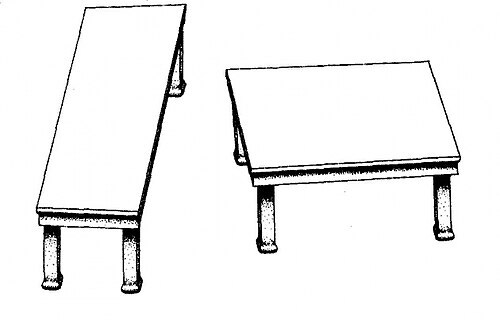
Perhaps the most famous example of this is Stanford and Bel Labs researcher Roger Shepard’s ‘Turning the Tables’ illusion below. These tables are exactly the same size and the same area. Even when one is rotated and placed on top of the other, people struggle to believe it. You will often find people printing it, cutting it out and placing one over the top, and still saying it can’t be right.
But for me, the clearest example of this is the illusion below. A and B are the same colour, it is really hard to believe that, most of us just cannot see it.
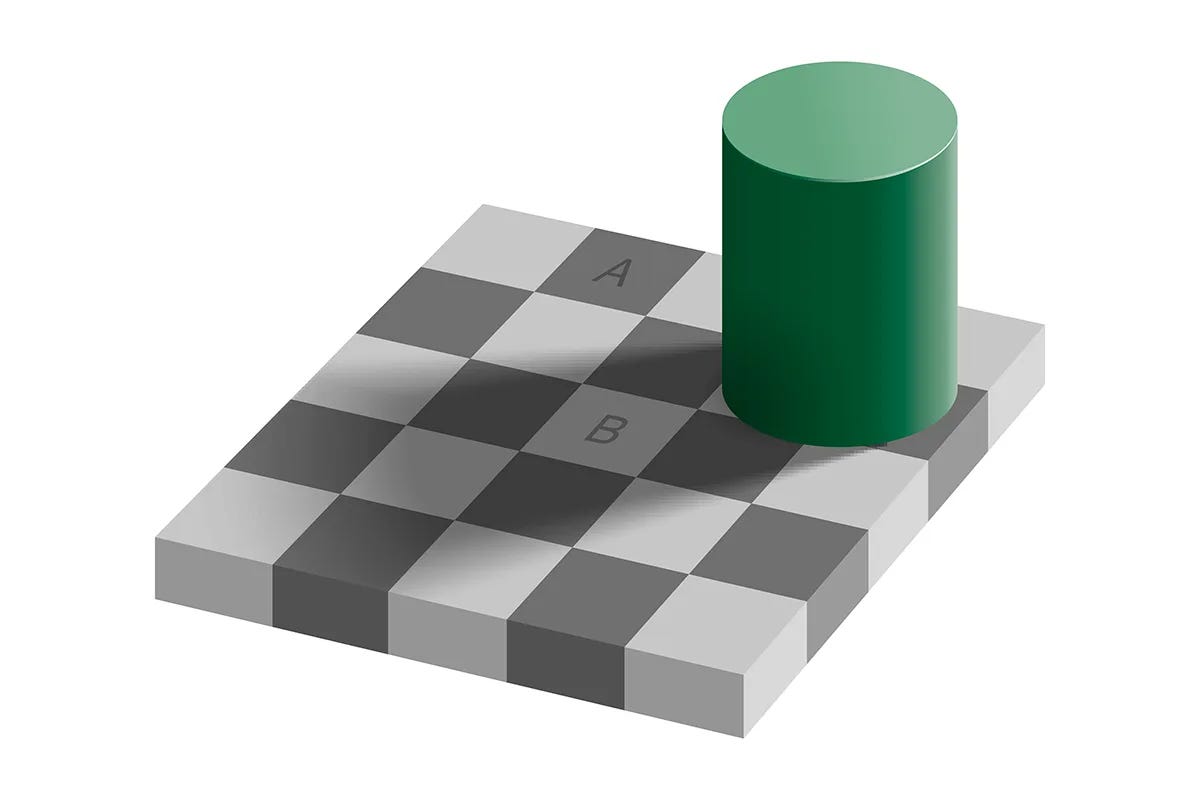
Photo: Edward H. Adelson / Wikipedia
Even when, as below, you are shown that the two squares are the same colour, you can only really see it for a few seconds. You know that it is true, but then, frustratingly, the illusion returns and the old interpretation reasserts itself.
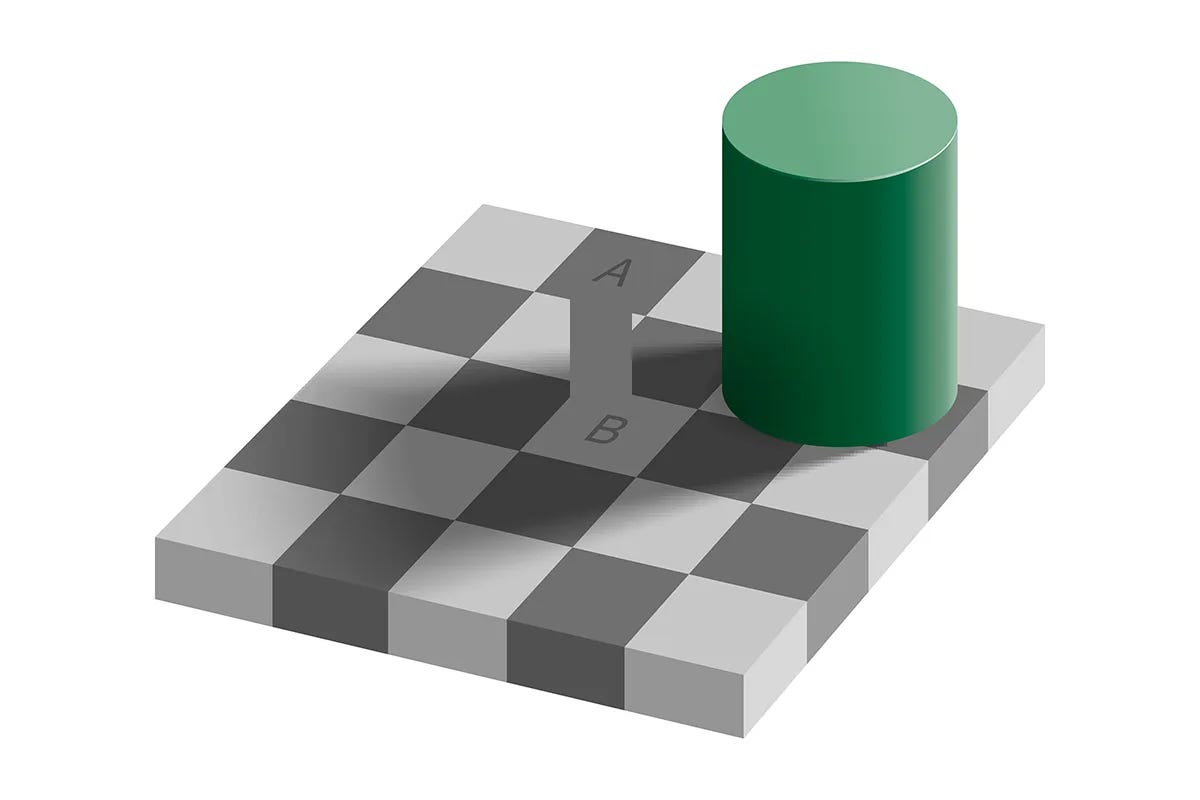
Photo: Edward H. Adelson / Wikipedia
It still feels wrong, even though we know it is right.
This is feels particularly relevant now.
AI is beginning to reveal strategic illusions across almost every category. It is challenging assumptions that, for a long time, made a great deal of sense. Assumptions about the value of junior work, the role of expertise, the structure of professional services such as accountancy and law, the relationship between effort and output, and even what customers may be willing to pay for.
Much of the conversation is still focused on how AI can make existing work faster, cheaper or more efficient. Those are, of course, important questions, but they are largely questions about how to automate the past.
The more difficult questions are about what strategic illusions might be built on assumptions we are still carrying forward from a world that may already be disappearing:
What are we treating as fixed because it has always been done that way?
What parts of our model are we trying to make more efficient when they may need to be redesigned entirely?
What are we failing to see because we are still looking through the old logic of the business we have built?
Seeing through strategic illusions requires more than better data, or even better analysis.
It requires a different way of seeing. It requires knowing where to look, and then being willing to interrogate what you find in a different way (it is one off the reasons I use the eight strategic sights as a foundational system, more in that soon). It requires the discipline to really open before closing down, to examine the assumptions beneath apparently sensible decisions, and to actively seek evidence that does not fit the current story.
If you are struggling to believe this is possible, science shows that it is.
A long time ago in the University of Durham Psychology department, as part of my dissertation, I took part in an experiment involving glasses that inverted my field of vision. At first, it was completely disorientating, deeply unpleasant, moving around was very strange. The simplest movement required a great deal of thought. The world no longer appeared to work in the way I had learned to expect it to.
Then, gradually, it began to normalise.
That feels important here in the context of strategic illusions. A different way of seeing does not arrive because someone has explained that the old one is incomplete. It comes through repeated contact with a reality that no longer fits the assumptions we brought to it. It requires practice. It requires brutal feedback. It needs having to make sense of something that initially feels wrong, that feels off unintuitive.
For organisations, this means creating more than moments of challenge or permission to speak. It means creating enough exposure to the emerging reality that the old view begins to lose its hold.
Psychological safety is important in this because it gives people permission to speak. But psychological empowerment takes it further than that, it creates an expectation that people will question what appears obvious, look for what does not fit, and keep looking when the first answer feels reassuring.
One thing to keep in mind: strategic illusions do not disappear simply because someone points them out, they begin to loosen when people learn to keep looking again.